Crushing quality control and granulometric composition analysis on a conveyor

Crushing quality control
in real time

System for analyzing the granulometric composition of material,
controlling oversize, foreign objects and material volume on a conveyor without waiting for a laboratory sample.

up to 80%less downtime
of crushers
up to 20%savings
energy
+5–15%increase in yield of acceptable
product
2–6 monthspayback
of the system
24/7continuous control
instead of samples between shifts
up to 90%reduction of manual
sieve control
Background

What production loses when material quality is seen too late

Sample-based control and visual assessment give a delayed picture. Production continues to operate in a non-optimal mode while the actual flow quality has already changed.

Delayed control

The crushing mode decision is made after the material flow has already changed.

Result: equipment works blindly.

Oversize and foreign objects

Large pieces and foreign objects increase the risk of blockage, damage and unplanned stops.

Result: crusher downtime risk increases.

Resource overconsumption

Excessive crushing increases energy consumption, liner wear and productivity losses.

Result: higher cost for the same volume.

No evidence base

Without an archive of frames and events, it is difficult to identify causes of deviations by shifts, batches and modes.

Result: decisions are made by feel.

Before: after-the-fact control

  • A laboratory sample shows a single point, not the flow dynamics.
  • The operator evaluates the particle-size composition visually and does not see the trend.
  • Oversize and deviations are detected too late.
  • Reports are collected manually, and deviation causes are lost.

After: managed process

  • Material quality is visible in the moment — between samples and shifts.
  • The system shows shares of fine, medium and coarse fractions, trends and anomalies.
  • The operator receives an event before a deviation becomes an accident or defect.
  • The measurement, event and frame archive forms an evidence base.
Solution

Continuous material control in the flow

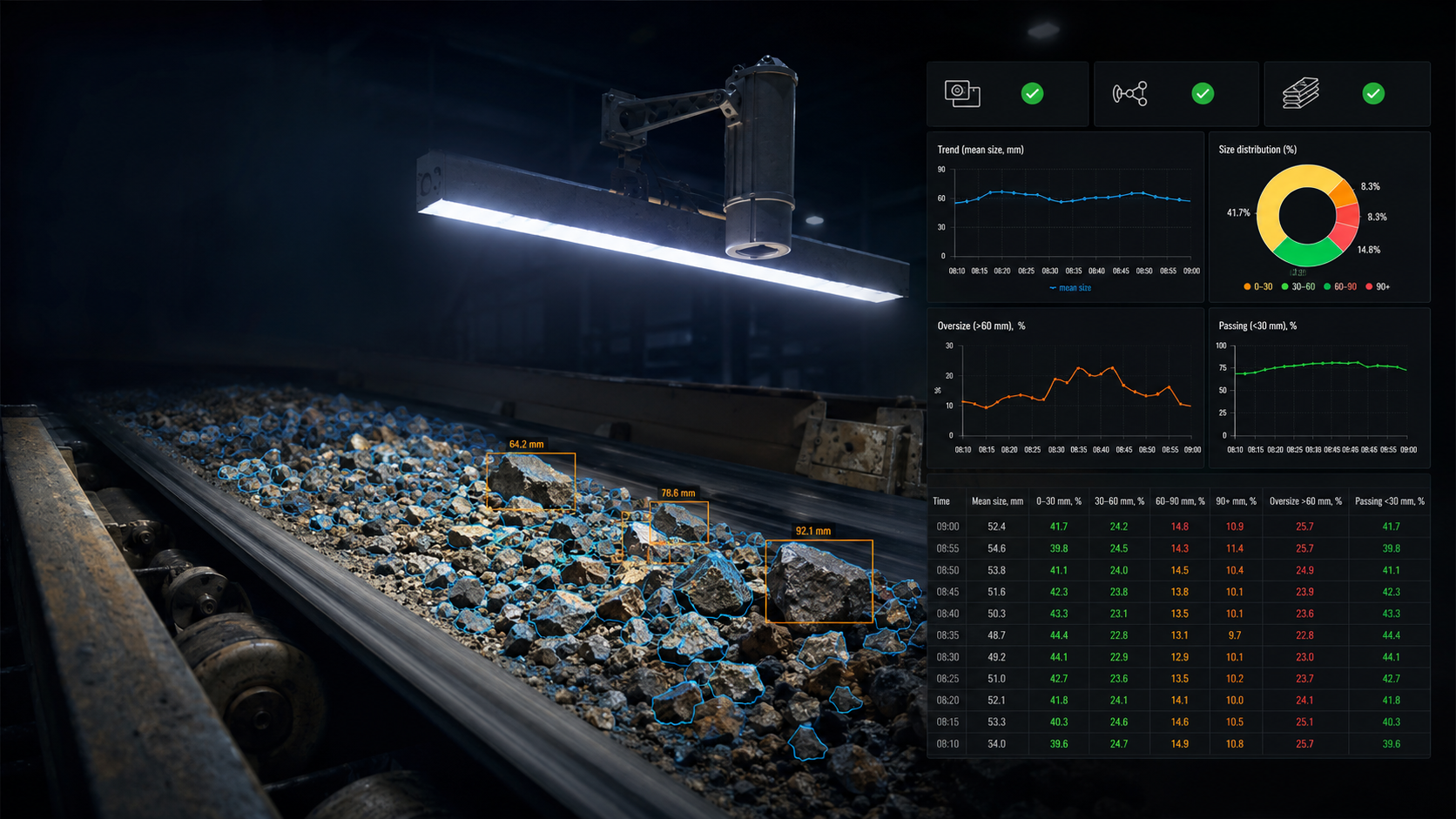
Algorithms continuously analyze video frames and perform granulometric composition analysis, calculate fraction distribution, detect oversize and foreign objects, determine material volume per unit of time and record flow dynamics.

Results go to the operator and technologist interface, are stored in the archive, used in reports and sent to enterprise systems — SCADA, MES, ERP, BI or other systems via API and industrial protocols.

Output Fraction distribution, D10 / D50 / D90, Dmax, oversize, foreign objects, volume and trends.
For whom operator, technologist, area manager, quality service, industrial automation and production management.
1The camera continuously captures the material flow on the conveyor
2Algorithms analyze each particle, detect oversize, foreign objects and the working zone
3The system calculates particle-size composition, fraction distribution, material volume and trends
4The operator and enterprise systems receive signals, reports, confirmation frames and action-ready data
What production sees clear KPIs for flow quality and deviations.
What IT / industrial automation receives archive, web interface, API and integration with existing systems.
Capabilities

Indicators understandable to managers and technologists

Continuous real-time analysis: from checking material presence and camera status to fraction analysis, oversize detection and control signals.

Granulometric composition

Share of fine, medium and coarse fractions in the flow.

  • distribution by classes and fractions
  • average size and Dmax
  • control signals to equipment

Equipment risks

Events that can lead to an accident, blockage or stop.

  • oversize and dangerous pieces
  • foreign objects
  • deviations from thresholds

Flow state

Factors that affect process stability and measurement quality.

  • material presence
  • volume and load
  • frame quality and optics contamination
Interface and reports

Dashboards, charts, events and confirmation frames

The operator sees alarms and the current picture, the technologist sees distributions and trends, and management sees KPIs by shifts, lines and objects.
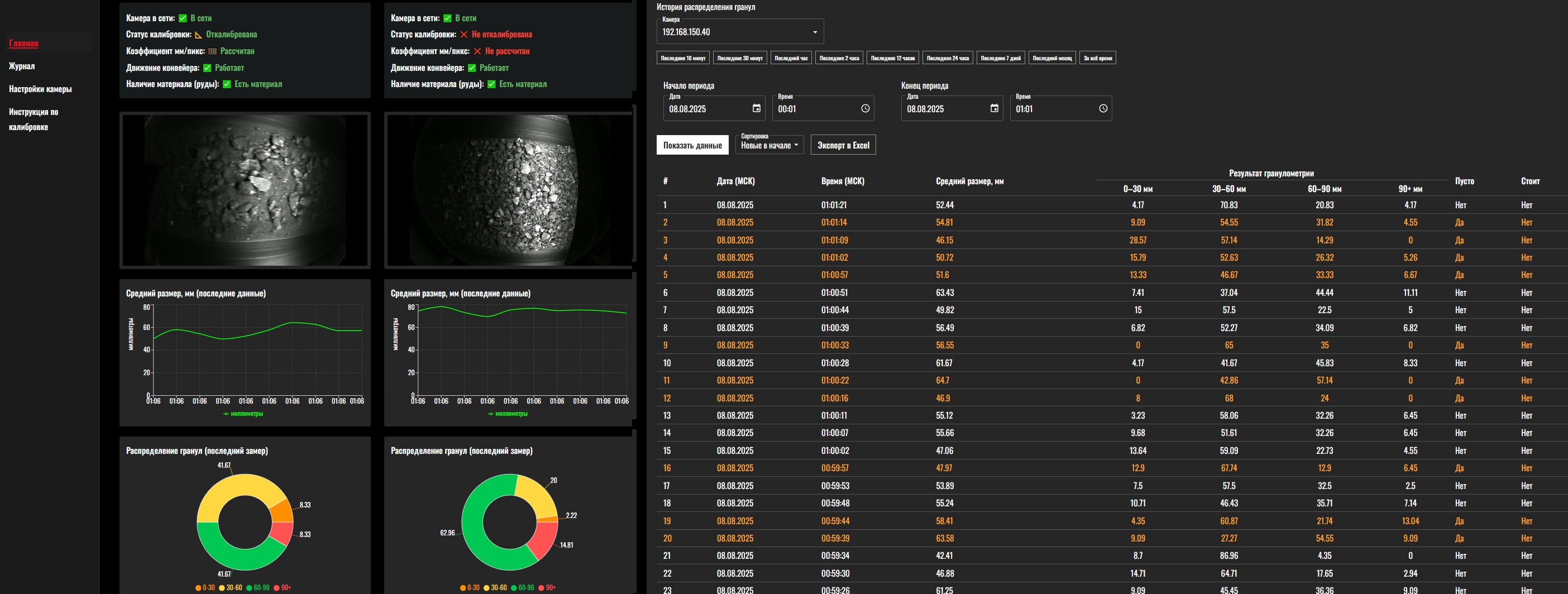
Main screen of the granulometric composition analysis system
Main system screen Video stream, current measurements, distributions, charts, event log and camera statuses.
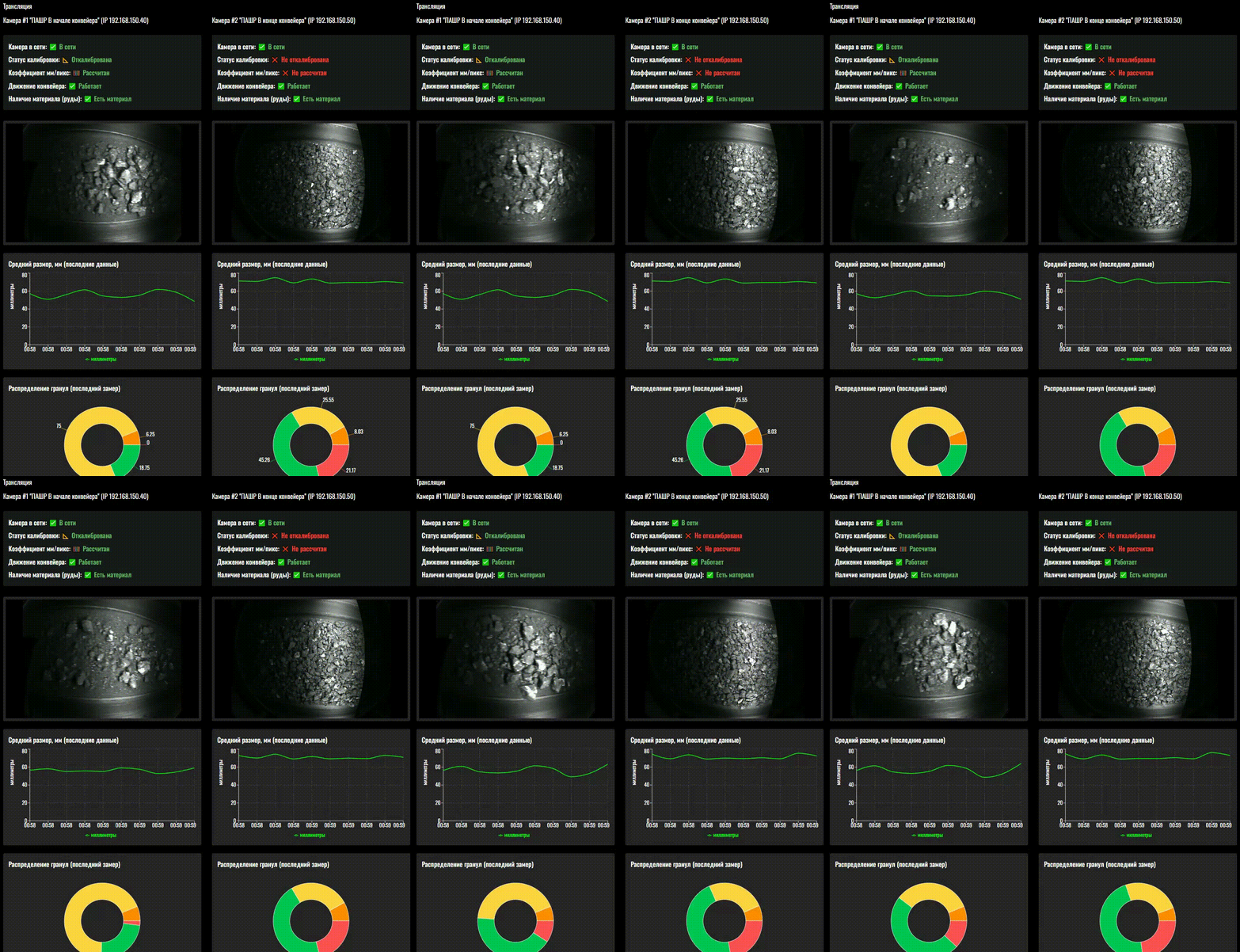
Real-time system operation
System operation Demonstration of material analysis and real-time indicator calculation.
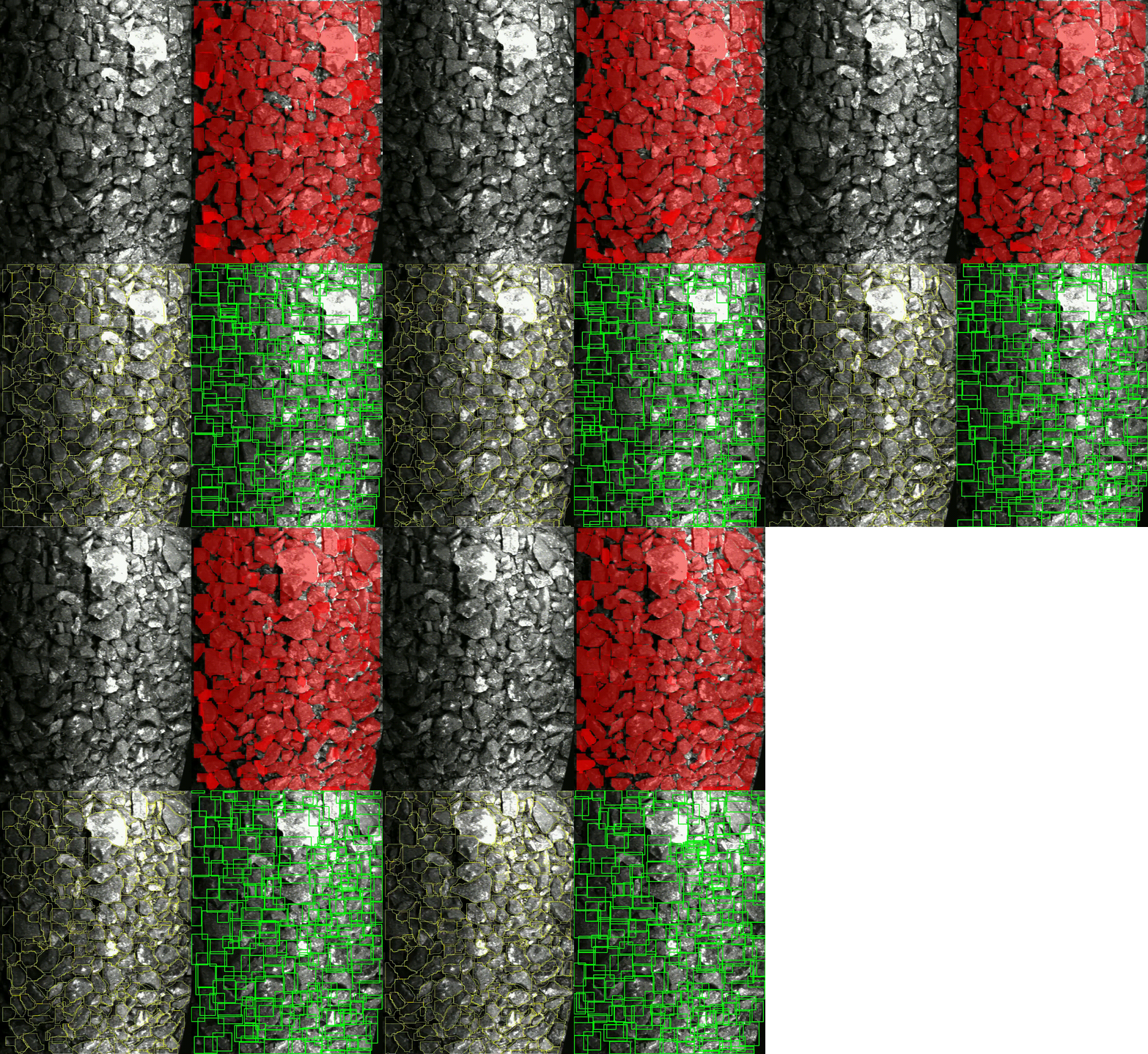
Material object segmentation
Object segmentation Particle and area extraction for calculating technologically significant characteristics.
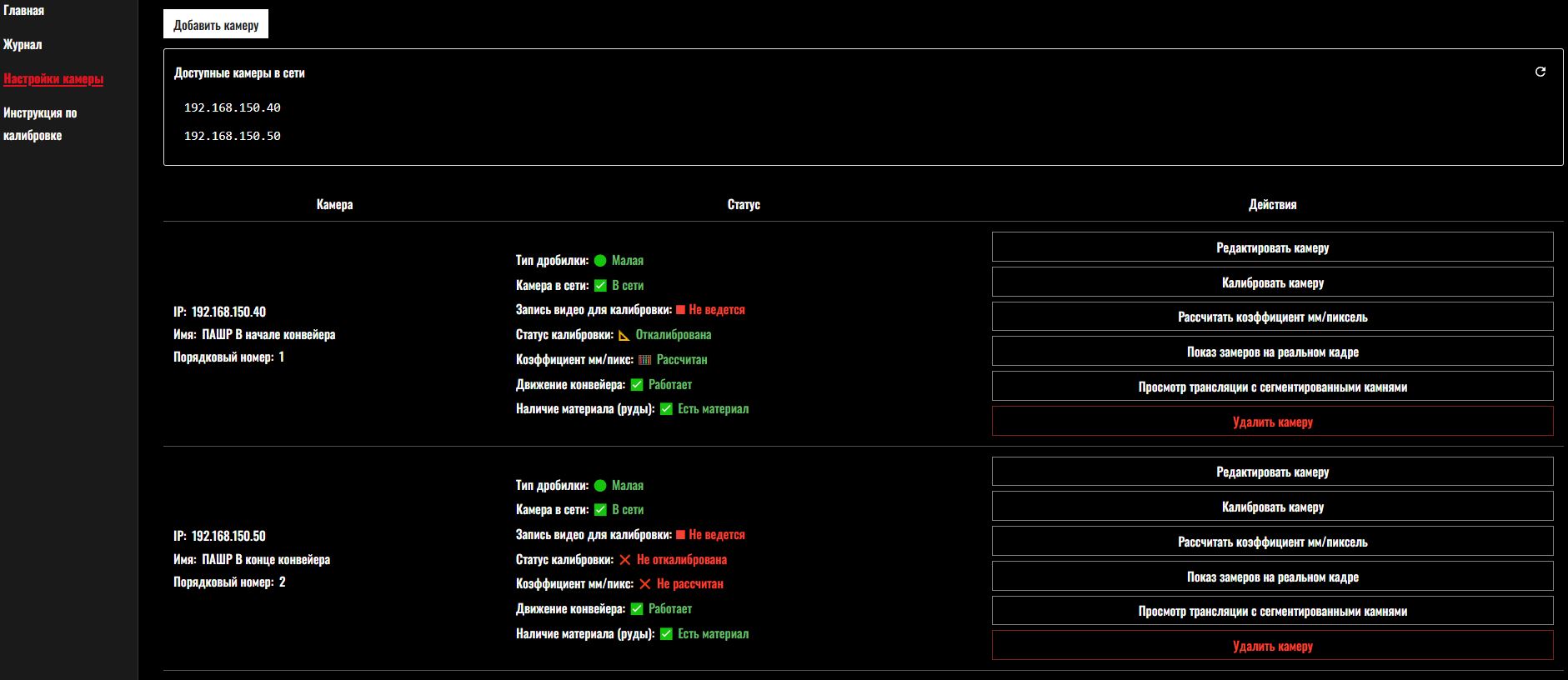
Camera setup
Camera setup Connected cameras, shooting parameters, calibration, stream statuses and data source control.
Technical implementation

Ready industrial solution with equipment, interface and integration

The solution includes not only algorithms, but also an industrial control point: camera, protective housing, lighting, optics cleaning, computing contour and integration into enterprise systems.

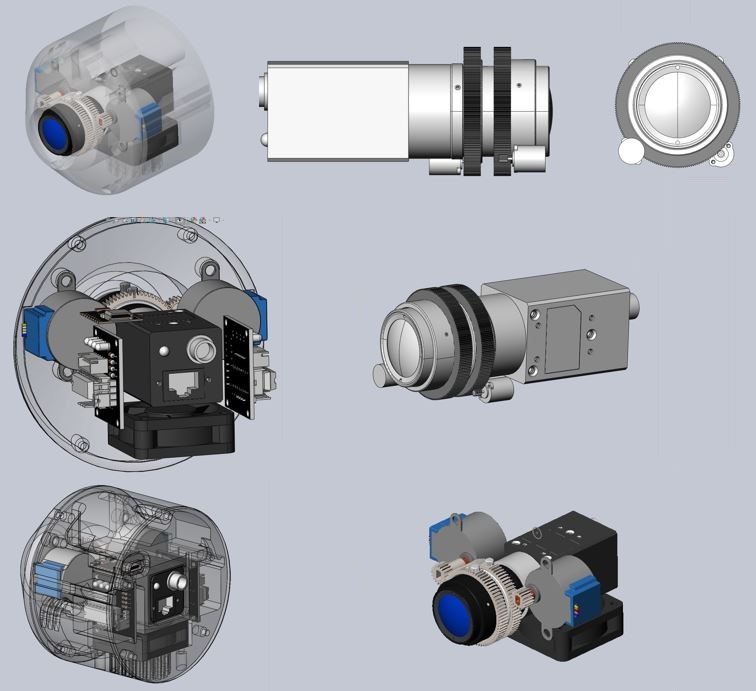
The device includes a machine vision camera with a lens and automatic focus adjustment module, an industrial computing unit, power and temperature control modules, a protective enclosure, and an air-blow and automatic optics cleaning unit. The system is designed for dust, vibration, complex lighting and local data processing requirements. Focus, zoom, exposure and working area can be configured remotely without opening the protective enclosure.
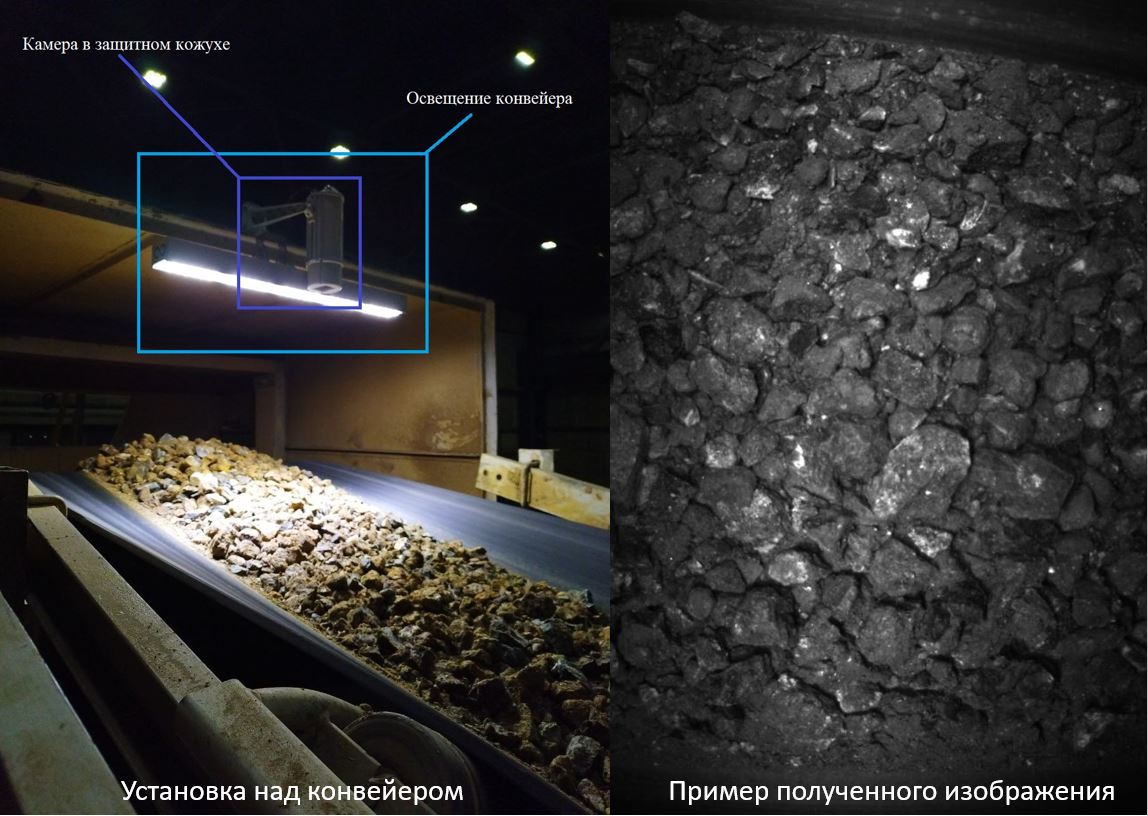
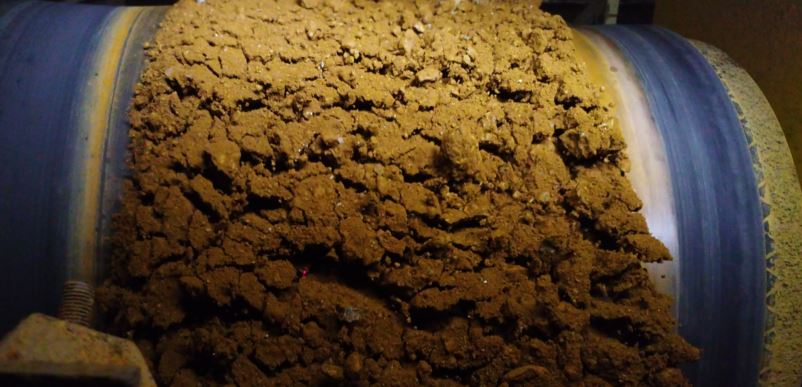
Example installation over a conveyor
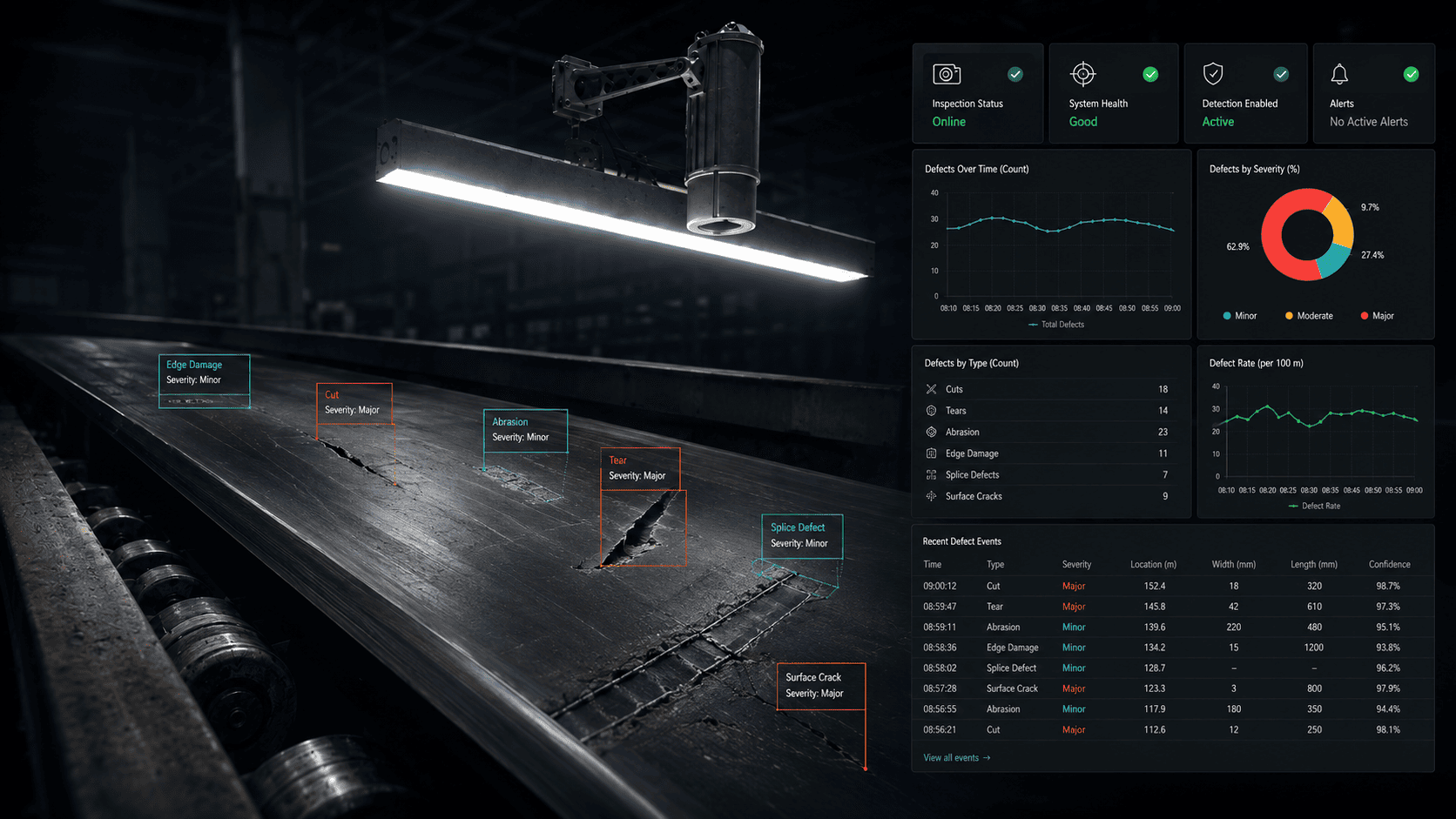
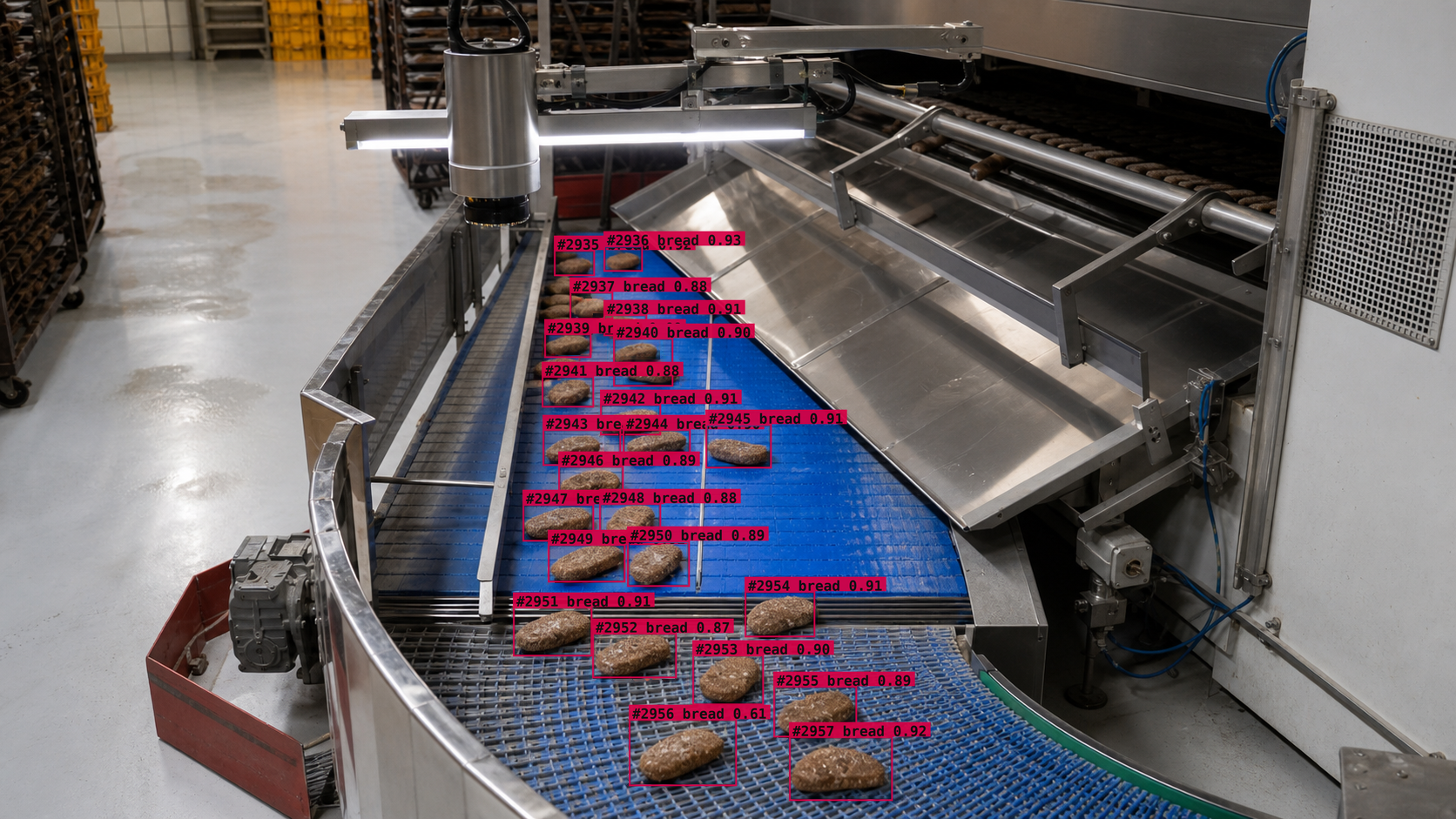
Example installation over a conveyorIndustrial control point with camera, lighting and an example of the resulting image.
Camera and lighting in the control zone
Camera and lighting in the control zonePlacement of the industrial camera and light line above the material flow.
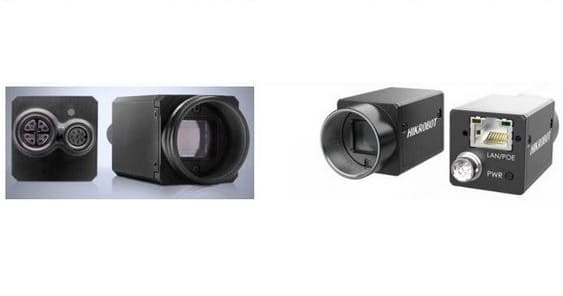
Industrial cameras
Example industrial camerasGlobal Shutter cameras.
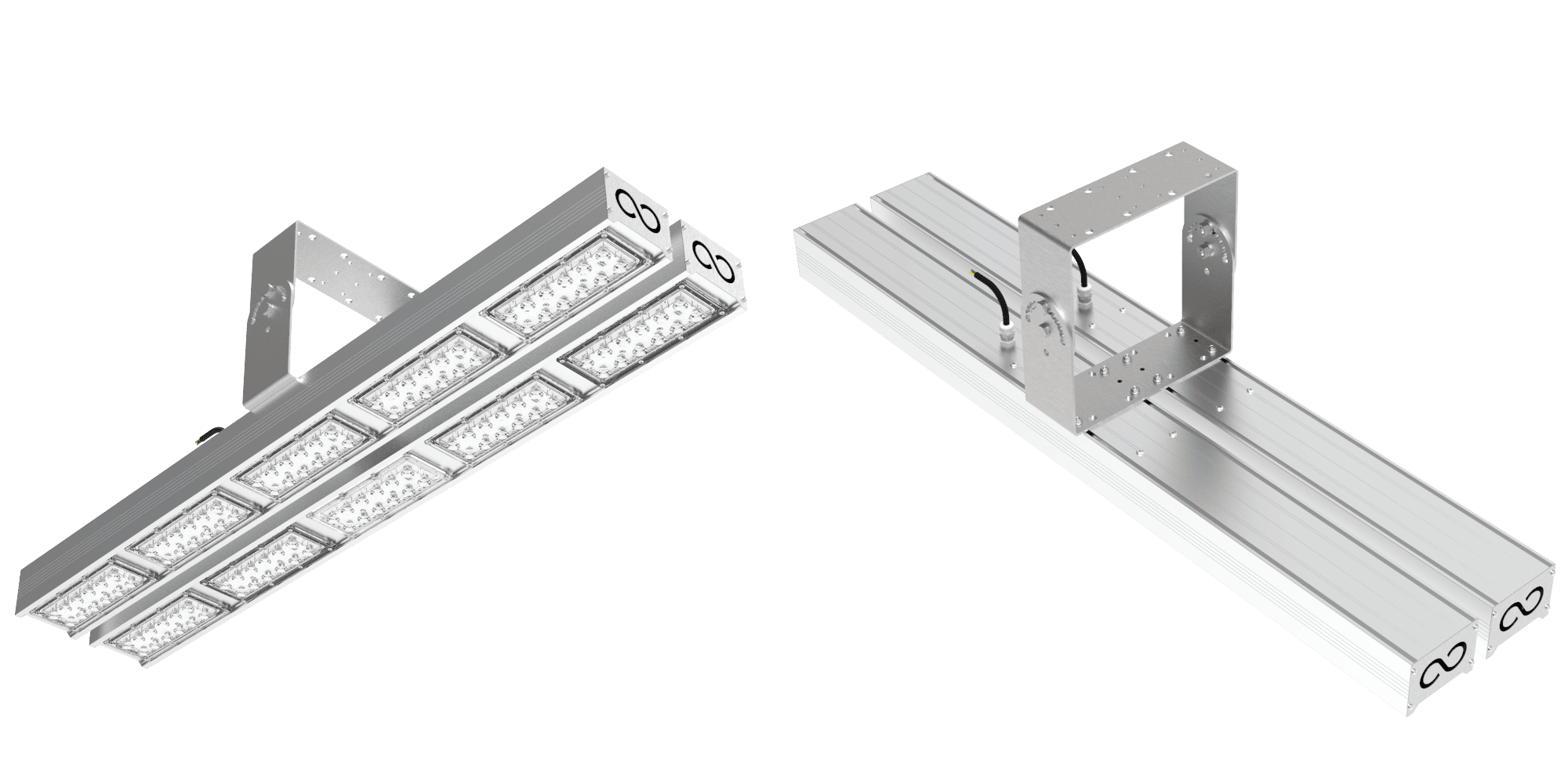
Industrial lighting
Industrial lightingDust- and moisture-protected IP67 LED floodlight for industrial lighting.
Equipment diagrams and drawings
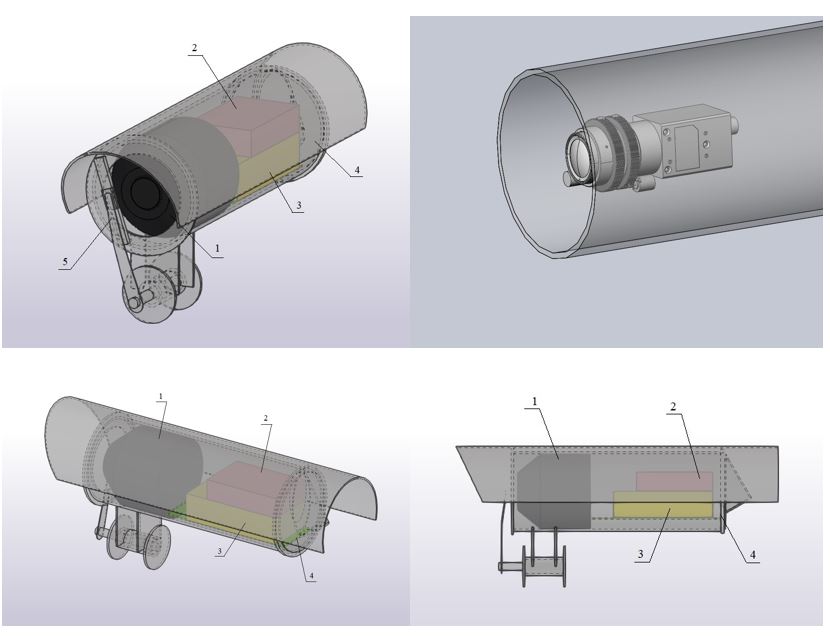
Control unit diagrams and drawingsLayout of the enclosure, optics, lighting and mounting unit for an industrial control point.
Control point components
Lens auto-adjustment moduleIntelligent configuration of shooting parameters.

Camera in protective housing

The industrial camera is installed above the conveyor with dust, vibration, maintenance access and measurement stability taken into account.

  • protective housing
  • industrial mounting
  • stable frame quality

Remote shooting setup

Focus, zoom, exposure and working area are configured remotely without opening the protective enclosure or extra site visits.

  • fast launch
  • less downtime
  • stable calibration

Local or server-side processing

Data can be processed at the customer's site: edge, local server or hybrid scheme, without external transfer.

  • event archive
  • web interface
  • access control

Integrations

The system integrates with any enterprise internal systems via API, databases and industrial protocols.

  • SCADA / MES / ERP / BI
  • Modbus-TCP / OPC UA
  • REST API / DB / files
Accuracy and acceptance

Accuracy is confirmed on your material

The system is compared with the customer's reference method: sieve analysis, laboratory data, manual annotation or an approved acceptance program. Final indicators are recorded in the test protocol.

Accuracy depends on material, lighting, layer height, camera angle, reference sample quality and operating conditions.

95%+ target accuracy for determining granulometric distribution under normal equipment operating conditions
from 0.1 mm measurable fraction range is configured for the material, optics, lighting and requirements of the specific control point
Our cases

Solutions for mining, chemical and construction industries

STATANLY projects are related to granulometric composition analysis, industrial images, material structure and control of technological deviations.

Nornickel • ore on conveyor • granulometry

Determining rock sizes in conveyor flow

Computer vision algorithms were developed to detect rocks on the belt, track objects in the video stream and build a size distribution.

The system is intended to automate granulometric composition assessment and support mill control based on data from a camera above the conveyor.

Result: software module for analyzing rocks in flow, calculating sizes and forming a size distribution.
EuroChem • conveyor • crushing • Modbus

Ore particle-size control system

A software and hardware complex was developed for real-time analysis of ore granulometric composition.

The system determines fraction distribution, detects oversize and foreign objects, sends measurement results to industrial control systems and generates control signals to change the crusher discharge gap via Modbus.

Result: operational control of crushed ore size and automatic maintenance of the target size class.
KNAUF • porization • foam generation

Material structure control and comparison with reference

A system was developed for operational analysis of gypsum mass porization and comparison of a sample with a reference image from a camera or microscope.

An additional foam-generation control scenario was developed: evaluating foam characteristics and sending an operator signal when deviations occur.

Result: software solution to reduce the human factor in assessing material structure and quality.

Want to test the solution on your material?

We will select the control point, reference method, set of indicators and pilot format for your line, material and production process.

Implementation

From one control point to industrial scaling

We start with a measurable pilot, confirm the effect, then extend the solution to lines, areas and adjacent scenarios.

01

Survey

1–3 days: control point, material, camera, lighting, dust, vibration, reference.

02

Connection

1–2 weeks: video stream, server, network, working zone and initial calibration.

03

Algorithm setup

2–6 weeks: algorithms, events, thresholds, interface, archive and reports.

04

Pilot and acceptance tests

1–2 months: comparison with reference, test protocol and effect assessment.

05

Scaling

New lines, cameras, materials, fractions and adjacent control modules.

Ready to check the economics at one control point?

We will select pilot scope, equipment, acceptance metrics and comparison format with your reference method.

Software registry

Software and documentation details

The software is included in the Russian software registry. Below are details on system purpose, rights holder, functional characteristics and documents.

Software registry No. 30185 Open registry extract

Name: System for analyzing group process-significant characteristics of objects densely located in an image.

Purpose: analysis of homogeneous grouped objects, granulometric composition analysis, detection of foreign objects, determination of ore volume on a conveyor, defects, oversize and camera data.

Main class 05.13 Tools for intelligent information processing and intelligent business process analysis.
Other classes 11.06 Image processing, analysis and recognition; 11.03 real-time analytical processing.
Capabilities Granulometry, foreign objects, ore volume, oversize, belt defects, flotation features and object classification.

Functional characteristics

IP cameras, web cameras and video files Ubuntu, Windows, Astra Linux detection, segmentation, classification bounding boxes, masks and labels multiple input sources CPU, GPU, TPU and edge devices
Rights holder

STATANLY LLC

Country of registration: Russia

Legal form: Limited liability company

OGRN: 1237800072982

INN: 7801724456

General Director: Sergey Olegovich Fedorov

License: OEM, FullPackageProduct, VolumeLicensing, Subscription