Cash regulations
Violations in the sequence of actions, cash handling and banknote-detector use are hard to identify online.

A unified video analytics layer for controlling cash processes, queues, SLA, security, ATMs, staff, compliance and KPIs across the branch network.
Cameras in branches, cash areas and ATM locations are already installed, but they usually work as an archive for post-incident review. AI turns CCTV into a source of events, KPIs, notifications and evidence for security, operations and service-quality teams.
Violations in the sequence of actions, cash handling and banknote-detector use are hard to identify online.
Queue length, waiting time and service-window load are often measured manually or with a delay.
Suspicious behavior, unattended items, ATM incidents and access to staff-only zones depend on operator attention.
Unified standards are difficult to scale: management needs objective KPIs by branch, region and shift.
The platform brings together video, events, rules, notifications, investigations and management reporting. A violation is no longer just a recording in the archive, but an event card with a frame, video fragment, status and owner.
Video streams are transformed into events, metrics, timings, zones and sequences of actions.
The cashier, controller or security team receives a near real-time signal instead of learning about the issue after a complaint.
Events are linked to video segments, processing statuses, comments and exportable reports.
Branch ratings, SLA, operational losses, security and efficiency are visible at network level.
Scenarios can be launched step by step: first quick modules for queues, SLA and security, then more complex process cases such as foreign-exchange operation control.
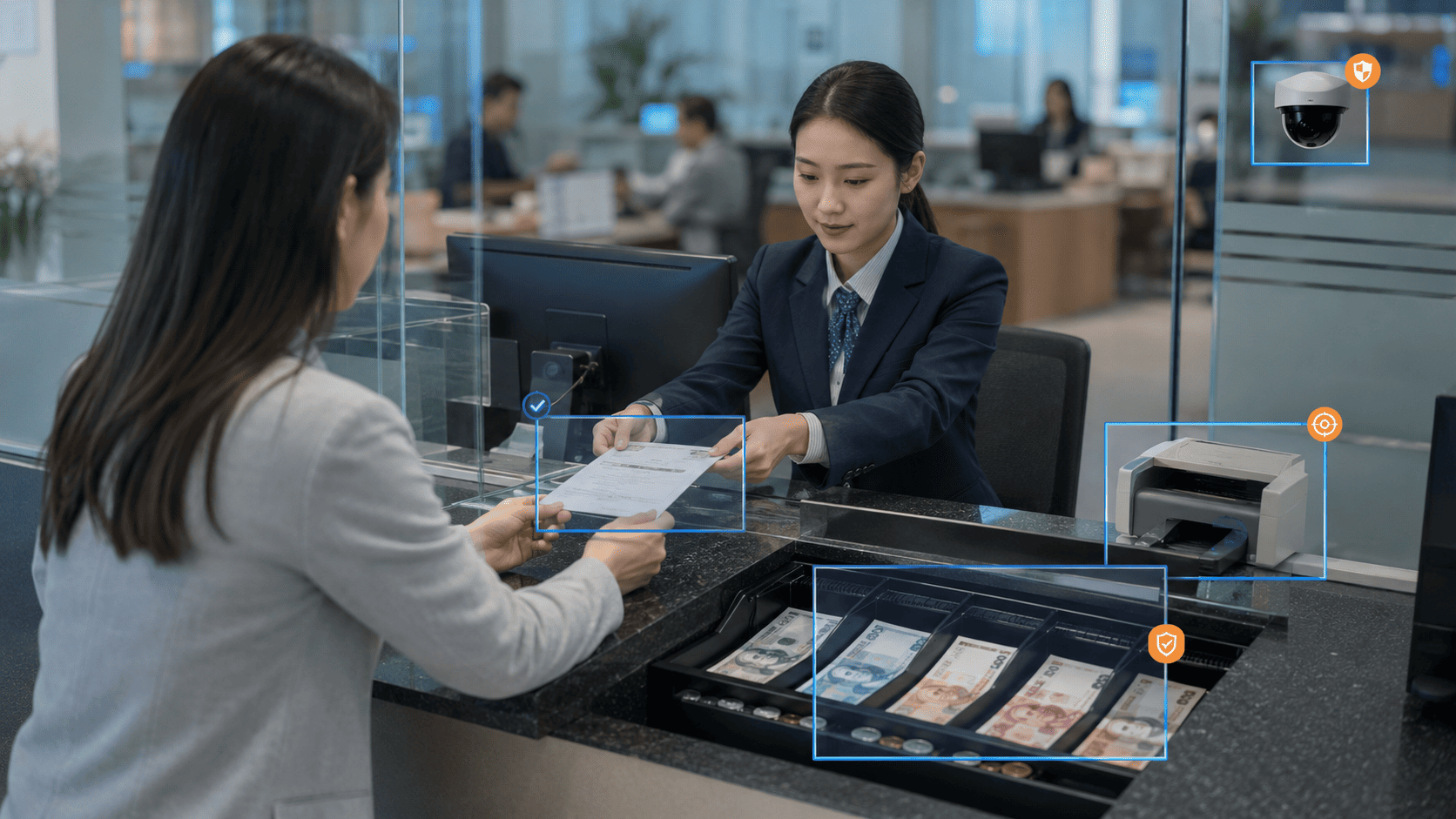 Cash desk
Cashier actions, cash drawer, banknote detector, cash, documents and process order.
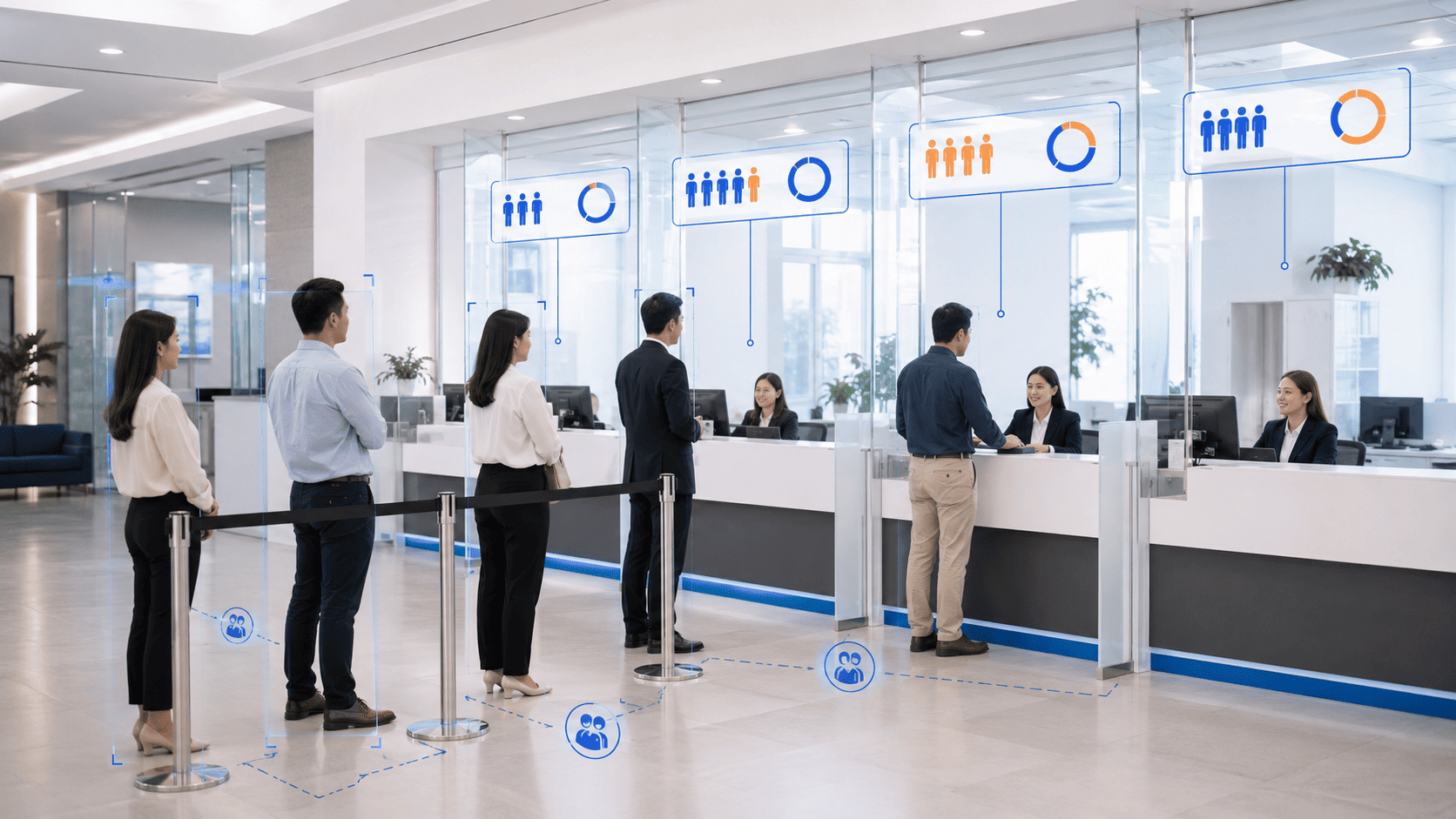 Hall
HallQueues, waiting time, window load, visitor counting, heat maps and SLA.
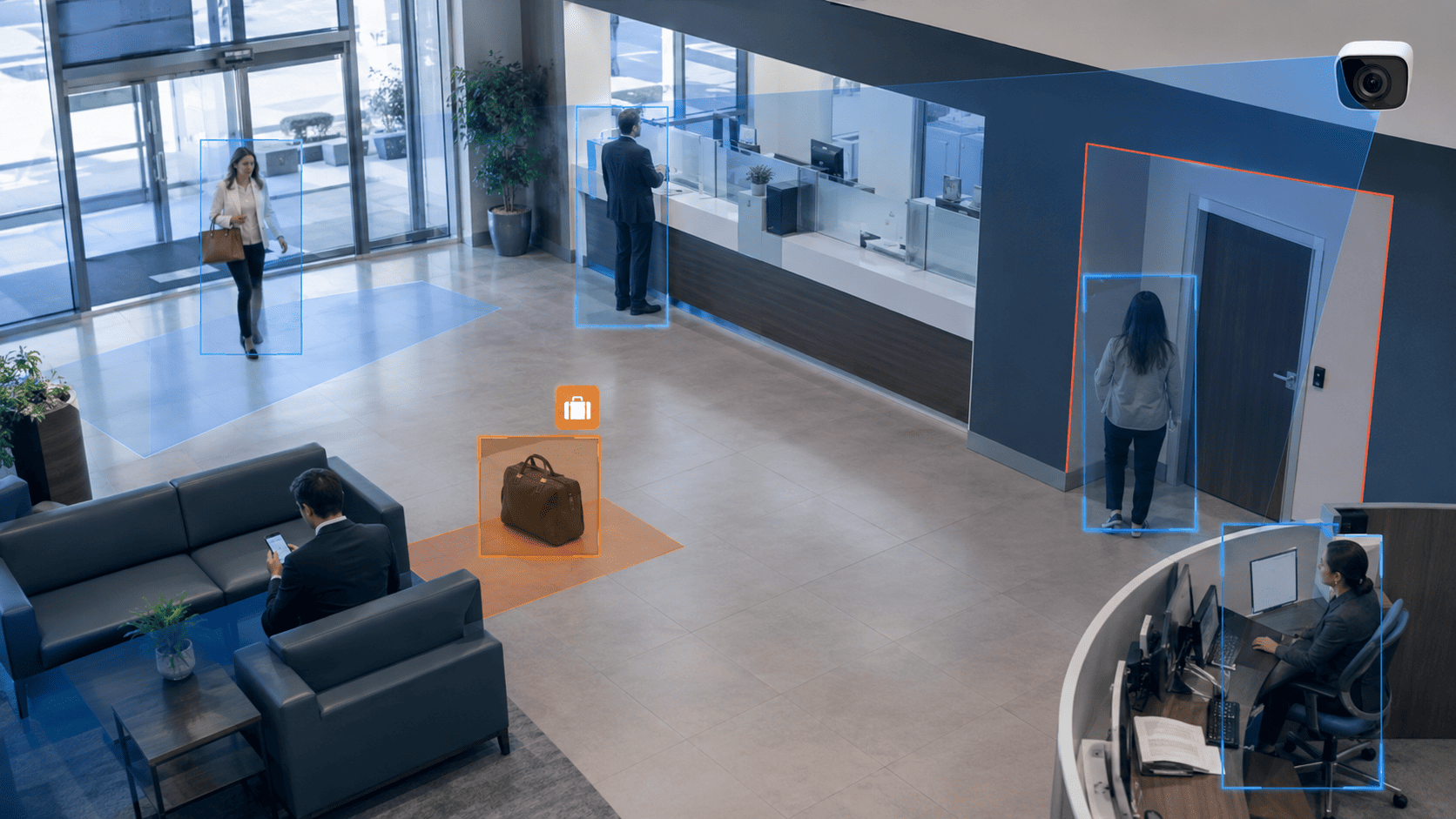 Security
Suspicious behavior, unattended items, conflicts, crowding and staff-only zones.
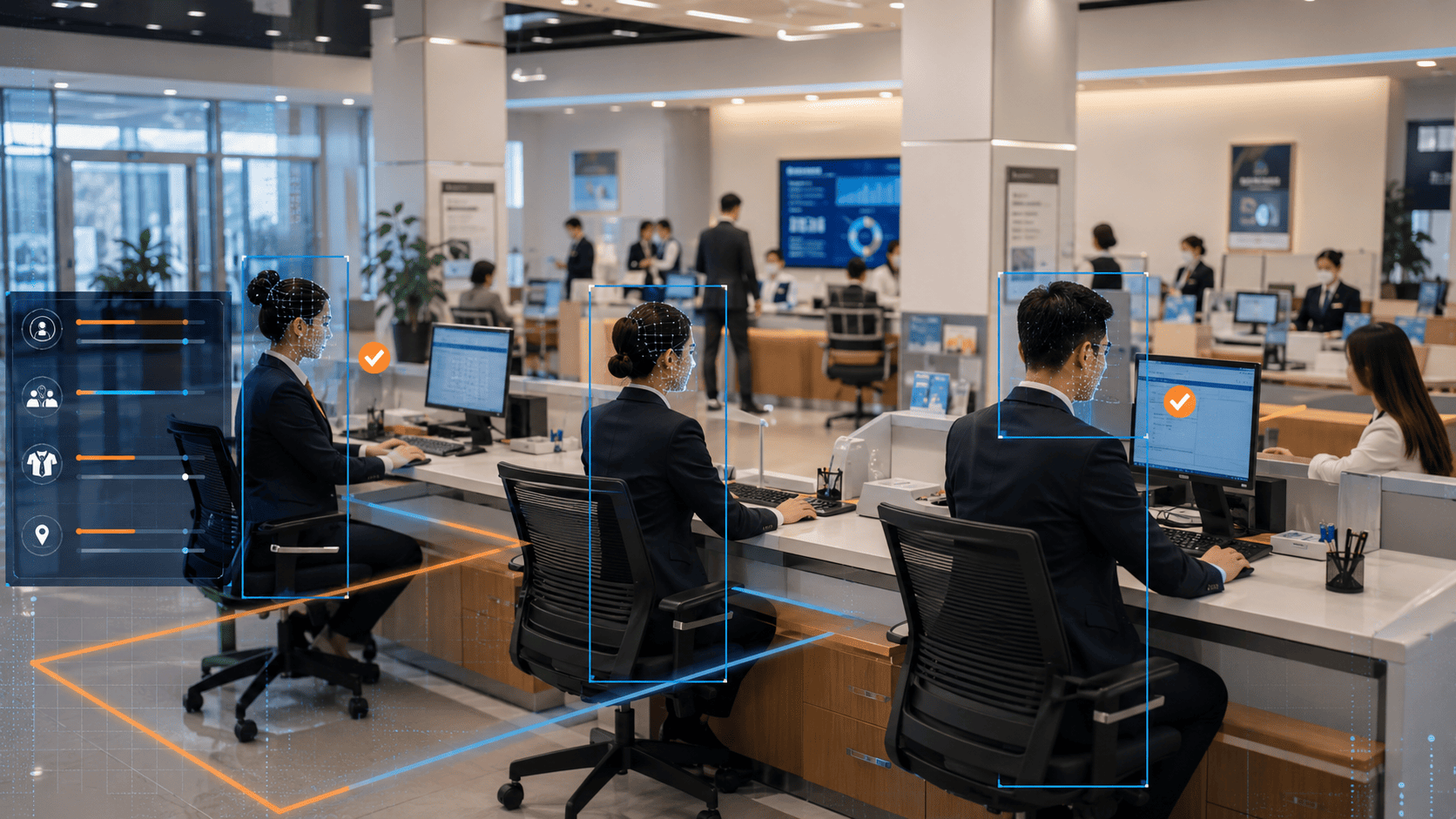 Staff
StaffPresence, uniform, badge, idle time, shift load, patrols and discipline.
 Speech
Dialogue quality, required phrases, complaints, conflict topics, cross-sell and script assessment.
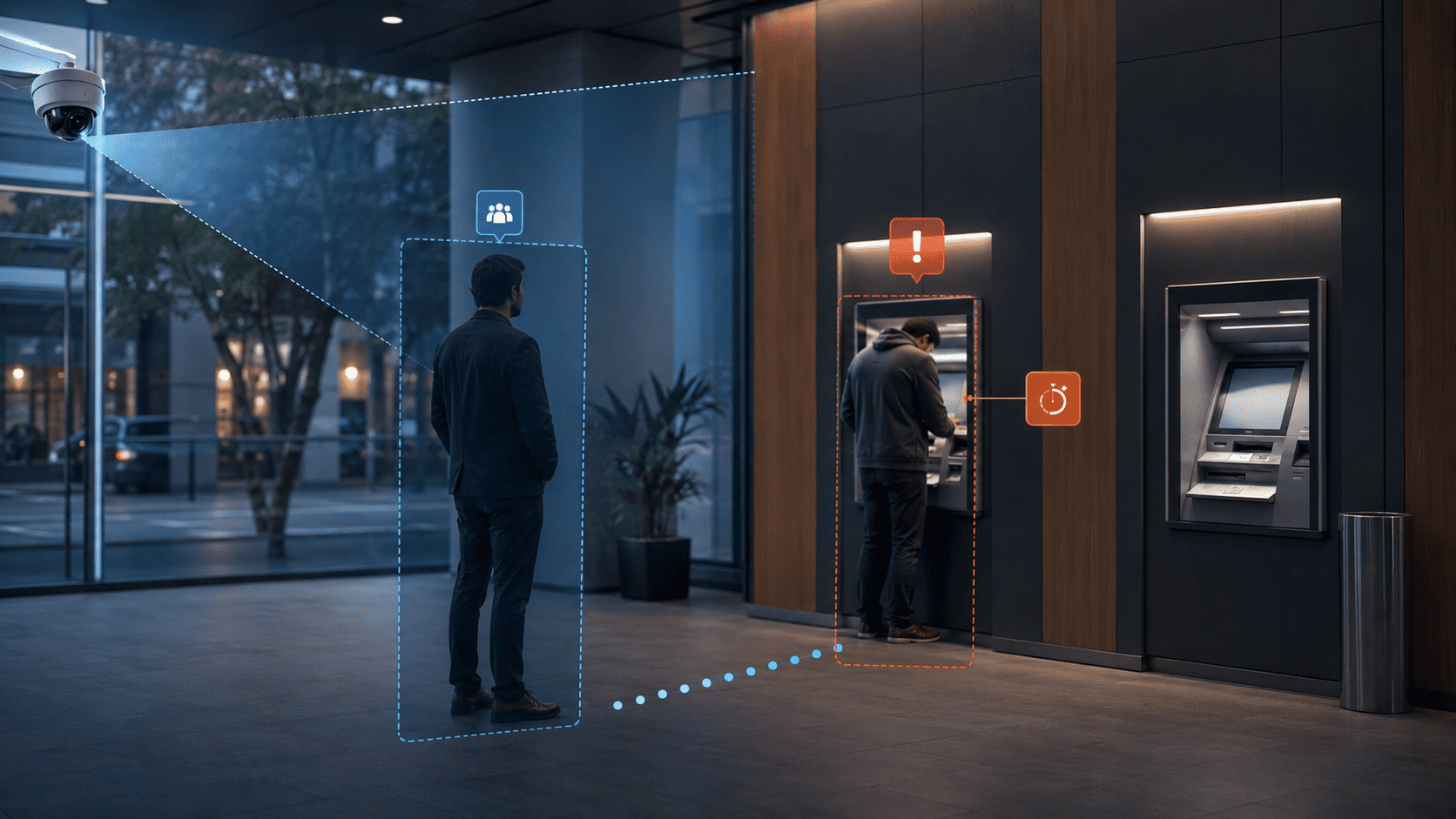 ATM
ATMLong dwell time, camera covering, vandalism, ATM queue and night incidents.
The system compares actual video events with the reference operation scheme: banknote intake, authenticity check, cash-drawer actions, registration, payout and closure.
Video analytics provides objective KPIs for branch load: how many clients came in, where a queue formed, how long the wait takes and when an additional window should be opened.
AI helps the operator avoid missing an event and quickly open the right video fragment. The system records physical risks in the hall, at ATMs, at the entrance and in staff rooms.
ATMs and self-service terminals operate outside the normal branch mode, so early events matter: long dwell time, attempts to cover the camera, vandalism, queues and night activity.
Notification if a person stays at the ATM longer than the configured time without a normal operation.
Detection of an attempt to block the view, turn the camera or degrade video quality.
Non-standard actions at the terminal, repeated approaches, inspecting the case or abnormal activity.
People counting, waiting time and self-service zone load during peak hours.
Hit, damage, attempted break-in, aggressive behavior and night incidents.
Event for scenarios where several people in the zone increase risk.
Monitoring stream availability and image quality to maintain archive continuity.
Control of scheduled work, patrols, access and device service time.
The platform shows staff presence at workplaces, shift load, idle time, compliance with uniform, badge, patrols and branch operating standards.
Each event is saved as a card with evidence: frame, video fragment, zone, time, status, owner, comment and processing history.
Video shows the fact of an action, while audio explains the context of the conversation. Speech analytics helps check scripts, required phrases, consultation correctness, complaints, conflict topics and service quality.
The interface separates operational work from management analytics: the branch processes events, security investigates incidents, and the central office sees network KPIs.
Key network KPIs: SLA, average wait, operational losses, security, incidents and branch ratings.
Filters by branch, region, camera, zone, event type, status, employee, shift and time.
Confirming frame, video fragment, process step, owner, processing history and export.
Comparison of sites by SLA, violations, service, security, cash processes and KPI dynamics.
A rational start is 1-2 branches, 10-30 video streams and quick scenarios with clear metrics. The complex FX case can be shown as target process analytics, but the first pilot is better started with queues, SLA, security and ATM events.
For the first stage, video quality, visibility of hands and zones, stream access, information-security requirements, user roles and clear success criteria are important.
Cameras, angles, processes, cash-zone visibility, information security and storage requirements.
Stream connection, basic events, zones, log and first response rules.
Fine-tuning, test violations, metric evaluation, stabilization and user roles.
Integrations, reports, ratings, delivery of models to branches and the control center.
Core bank scenario: processing, events, archive, roles and reports inside the bank infrastructure.
Local processing of sensitive video plus centralized analytics and model updates.
Possible for less sensitive environments, pilots or centralized reporting when allowed by the bank policy.
The platform supports a model library, fine-tuning for bank regulations, VLM/GenAI for new scenarios, no-code rules, versioning and delivery of models to branches.
Events and KPIs can be sent to VMS/NVR/CCTV, core banking, cash software, CRM, Service Desk, SIEM/SOC, BI/DWH, LDAP/SSO and internal APIs.
We will agree on a fast pilot scenario: queues and SLA, security, ATM, staff or cash process. We will validate the value on real video streams inside the bank environment.